📢 Mains Answer Writing Programme - Coming Soon•
📝 Email - contact@civilmentor.in•
📚 Download NCERT Books•
🎯 Daily Targets & Accountability•
🚀 Join Our Telegram Community
📢 Mains Answer Writing Programme - Coming Soon•
📝 Email - contact@civilmentor.in•
📚 Download NCERT Books•
🎯 Daily Targets & Accountability•
🚀 Join Our Telegram Community

Rare Earth Permanent Magnets: India’s Strategic Push for Energy Transition
Rare Earth Permanent Magnets (REPMs) are high-performance permanent magnets that retain their magnetism without continuous external energy.

📌 GS Paper Mapping for UPSC
- Prelims: Rare earth elements, NdFeB magnets, critical minerals, National Critical Mineral Mission, REPM manufacturing scheme, rare-earth value chain.
- GS Paper 2: International Relations — supply-chain dependence and strategic economic relations.
- GS Paper 3: Science & Technology; Critical Minerals; Manufacturing; Energy; Infrastructure; Environmental sustainability.
Why in News?
A key weakness in India’s rare-earth strategy has been highlighted, possessing mineral resources or reducing imports alone does not ensure technological self-reliance. The real challenge lies in developing capabilities across the entire permanent-magnet value chain, from mining and processing to finished magnets.
This is particularly important because Neodymium-Iron-Boron (NdFeB) magnets are critical components in electric vehicles, wind turbines, advanced electronics, aerospace and defence systems.
What are rare earth elements?
Rare earth elements (REEs) comprise 17 elements — the 15 lanthanides along with Scandium and Yttrium.
Despite their name, many rare earth elements are not exceptionally rare in the Earth’s crust. The challenge is that they are often found in low concentrations, occur together, and require technically complex processes for extraction and separation.
What are rare earth permanent magnets?
Rare Earth Permanent Magnets (REPMs) are high-performance permanent magnets that retain their magnetism without continuous external energy.
Important types include:
- Neodymium-Iron-Boron (NdFeB)
- Samarium-Cobalt (SmCo)
Among them, NdFeB magnets are particularly important because they provide very high magnetic strength relative to their weight and size. The Hindu describes them as central to the energy-transition and advanced-manufacturing ecosystem.
Why are they strategically important?
REPMs are used in:
- Electric vehicle motors
- Wind-turbine generators
- Industrial motors
- Robotics
- Consumer electronics
- Aerospace systems
- Defence equipment
- Precision instruments
Thus, the availability of REPMs has implications not only for green transition, but also for industrial competitiveness and strategic autonomy.
India’s Rare-Earth Value Chain
The key issue is that having rare-earth resources ≠ having a rare-earth manufacturing ecosystem.
The value chain broadly runs as:
Exploration → Mining → Mineral processing → Chemical separation → Rare-earth oxides → Metals → Alloys → Magnetic materials → Finished magnets → End-use products
Each stage requires different technological and industrial capabilities.
India’s strategic vulnerability lies not merely in its mineral resources or dependence on Chinese imports, but in understanding where technological dependence accumulates along this value chain.
Key Provisions / Features of India’s Policy Push:
- Scheme to Promote Manufacturing of Sintered REPMs
The Union Cabinet approved a dedicated scheme to establish an integrated domestic REPM manufacturing ecosystem.
Key features:
- Total financial outlay: ₹7,280 crore
- Target capacity: 6,000 metric tonnes per annum (MTPA)
- Beneficiaries: Five selected through competitive bidding
- Maximum capacity per beneficiary: 1,200 MTPA
- Sales-linked incentive: ₹6,450 crore over five years
- Capital subsidy: ₹750 crore
- Gestation period: Two years
- Incentive period: Five years
- Total scheme duration: Seven years
The scheme seeks to create an integrated manufacturing chain, covering conversion of rare-earth oxides into metals, metals into alloys and alloys into finished magnets.
- Rare Earth Corridors
The Union Budget 2026–27 announced dedicated Rare Earth Corridors in:
- Odisha
- Kerala
- Andhra Pradesh
- Tamil Nadu
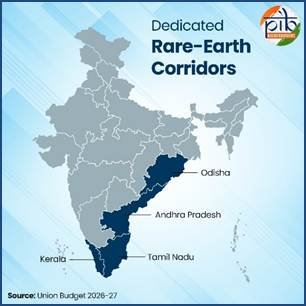
The objective is to develop an ecosystem covering mining, processing, research and REPM manufacturing.
- National Critical Mineral Mission (NCMM)
The NCMM seeks to strengthen India’s critical-mineral value chain covering:
Exploration → Mining → Beneficiation → Processing → Recycling/recovery
It has an overall government expenditure of ₹16,300 crore for FY 2024–25 to FY 2030–31, alongside an expected ₹18,000 crore investment by public-sector undertakings.
- Indigenous technology development
A pilot plant for manufacturing NdFeB permanent magnets has been established at ARCI, Hyderabad, under the Department of Science and Technology.
The facility follows an end-to-end approach from strip-cast alloy to finished sintered magnets and is intended to facilitate technology validation, process optimisation and eventual commercialisation.
India’s Resource Base
India possesses significant rare-earth resources.
According to government data:
- 13.15 million tonnes of monazite contain approximately 7.23 million tonnes of in-situ Total Rare Earth Oxide equivalent.
- Resources occur in states including Odisha, Andhra Pradesh, Tamil Nadu, Kerala, West Bengal, Jharkhand, Gujarat and Maharashtra.
- Additional hard-rock REE resources have been identified in Gujarat and Rajasthan.
- GSI has identified 482.6 million tonnes of rare-earth ore resources through exploration projects.
However, India remains dependent on imports for rare-earth magnets and related products, reflecting weaknesses in downstream processing and manufacturing capacity.
Why China Matters?
China occupies a dominant position in several stages of the global rare-earth supply chain, particularly processing, refining and magnet manufacturing.
The Hindu article notes that China’s export controls on rare-earth magnets and materials in 2025 exposed vulnerabilities in global industrial supply chains.
Key Challenges for India:
- Mining is only the first step
India’s resource base does not automatically translate into domestic magnet production.
- Processing and separation gaps
The conversion of ore into high-purity rare-earth oxides and subsequently into metals and alloys is technologically demanding.
- Supply-chain concentration
Global processing and manufacturing remain highly concentrated, creating vulnerability to export restrictions and geopolitical disruptions.
- Weak industrial mapping
India’s statistical system does not provide a sufficiently integrated picture of the permanent-magnet economy. It proposes an Integrated Techno-Economic Mapping (ITEM) framework to map the journey from minerals to finished products.
- Environmental concerns
Rare-earth extraction and processing can generate significant environmental impacts and, in some deposits, involve radioactive elements such as thorium.
- Technology and skilled manpower
Advanced magnet production requires specialised expertise in metallurgy, chemical separation, materials science and precision manufacturing.
Way Forward
India needs to move from a “mineral security” approach to a “technology and value-chain security” approach.
- Develop an integrated mineral-to-magnet ecosystem.
- Strengthen domestic separation and refining capacity.
- Promote R&D in NdFeB and alternative magnet technologies.
- Establish systematic techno-economic mapping of the magnet value chain.
- Build strategic partnerships with resource-rich countries.
- Encourage recycling of rare earths from end-of-life electronics and EV components.
- Integrate REPM policy with India’s EV, renewable-energy, electronics and defence-manufacturing strategies.
- Maintain diversified international supply chains rather than replacing one dependency with another.
Mains Practice Question
Q. “Possessing critical mineral resources does not necessarily translate into strategic autonomy.” Discuss in the context of India’s rare-earth permanent magnet ecosystem.
Prelims Practice Question
Q. With reference to Rare Earth Permanent Magnets (REPMs), consider the following statements:
- NdFeB magnets are important for electric vehicle motors and wind-turbine generators.
- India’s REPM manufacturing scheme aims to create 6,000 MTPA of domestic capacity.
- The Rare Earth Corridors announced in Budget 2026–27 include Odisha, Kerala, Andhra Pradesh and Tamil Nadu.
- Rare-earth permanent magnets are used exclusively in renewable-energy technologies.
Which of the statements given above are correct?
A. 1, 2 and 3 only
B. 1 and 4 only
C. 2 and 3 only
D. 1, 2, 3 and 4
Answer: A. 1, 2 and 3 only
Explanation: NdFeB magnets have applications across EVs, wind energy, electronics, aerospace and defence. The Indian scheme targets 6,000 MTPA, while the four states constitute the announced Rare Earth Corridors; therefore statement 4 is incorrect.